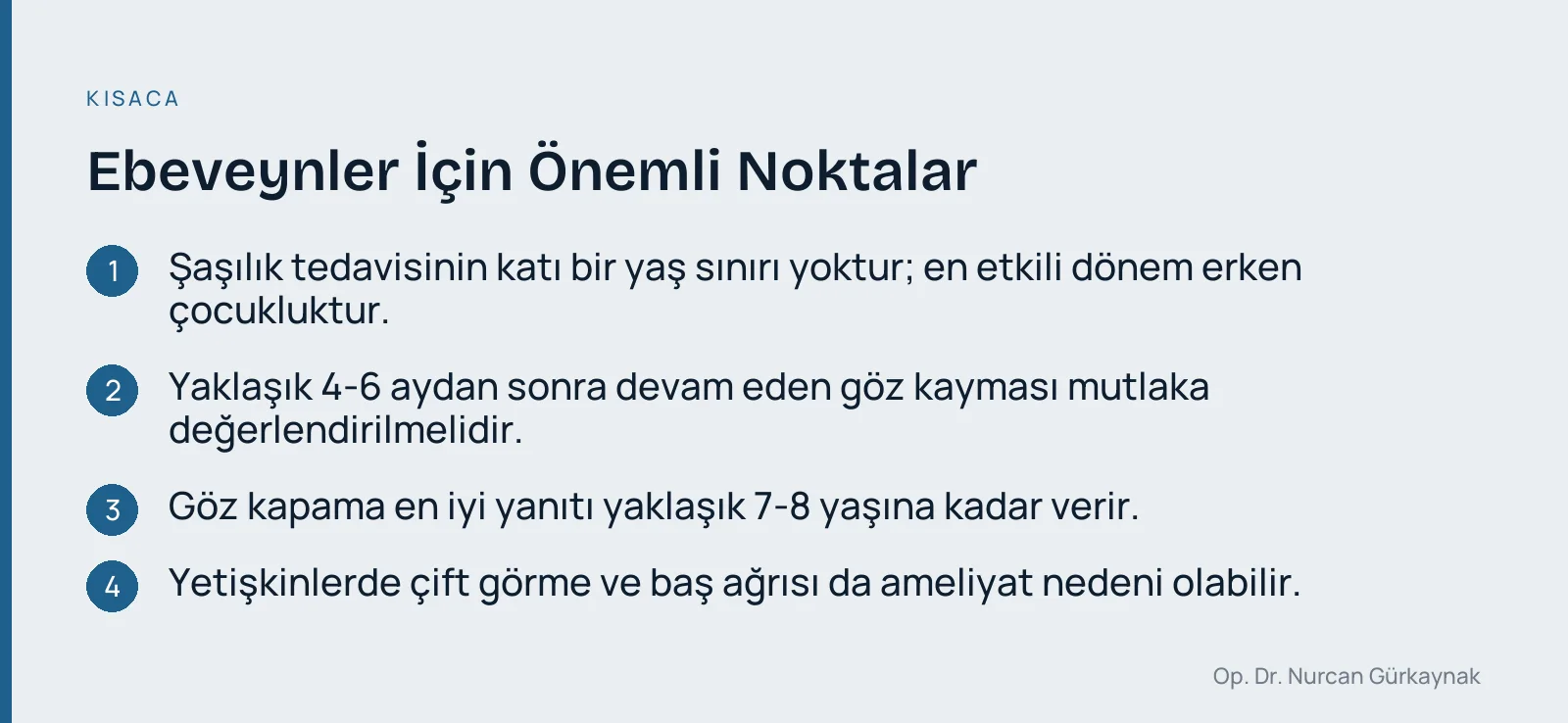
There is no strict upper age limit for strabismus treatment, but early childhood is the most effective period when it comes to lazy eye development. Strabismus is a condition in which the two eyes cannot look at the same point at the same time. That is why the question for parents should be less "until what age?" and more "when should we start?" Because the visual system is still developing in children, an early examination widens the treatment options. In suitable cases, adults can be treated as well.
What is strabismus? A short definition and the basics
Strabismus is a disorder of eye muscle coordination in which one eye turns inward, outward, upward or downward. The misalignment may be constant, or it may appear only when the person is tired or looking into the distance.
The main causes of strabismus in children are:
- Undetected refractive errors (such as farsightedness) and the eye strain that results from them
- A difference in prescription between the two eyes
- An imbalance in the eye muscles
- A family history of strabismus
- Rarely, another condition affecting the eye or the nervous system
In newborns, a slight misalignment seen from time to time in the first months can be normal. However, a misalignment that persists after about 4-6 months must always be evaluated.
Until what age can strabismus be treated?
There is no rigid age limit for strabismus treatment. From infancy through later years, treatment can be planned by choosing the method that suits the individual. Age only determines which method will work and how effective it will be.
The key issue is the risk of developing lazy eye (amblyopia). The visual system develops during childhood. The brain of a child with strabismus may suppress the image coming from the misaligned eye to avoid double vision. If this is left untreated, visual development in that eye can lag behind. Specialists note that the period when visual development is most flexible is strongest in the preschool years and up to the start of school age. For this reason, lazy eye treatment should be started as early as possible.
Treatment approach by age: child or adult?
The goals differ somewhat in each age group:
| Age group | Main goal | Commonly used methods |
|---|---|---|
| Infants and preschoolers | Preventing lazy eye and equalizing vision | Glasses, eye patching, surgery when needed |
| School age | Supporting vision and strengthening the use of both eyes together | Glasses, orthoptic exercises, surgery |
| Adults | Correcting eye alignment and relieving double vision and appearance-related discomfort | Prism glasses, surgery, exercises in some cases |
Can strabismus surgery be performed on adults?
Yes, strabismus surgery can be performed on adults. In adults, the goal is not only to improve appearance. Complaints such as double vision, headaches, eye strain and discomfort in social situations can also be reasons for surgery. If an adult has a lazy eye dating back to childhood, vision in the two eyes may not be fully equalized. This is why a detailed examination is needed before surgery, so that realistic expectations can be set. Results vary from person to person, and an evaluation by a specialist is essential.
What is orthoptic treatment and how is it done?
Orthoptic treatment is an exercise-based approach that aims to improve how the two eyes work together, as well as focusing and eye movements. In suitable cases, it may be preferred, particularly for conditions such as intermittent outward deviation and difficulty when looking at close objects.
- Near-focusing and eye movement exercises are carried out.
- Activities aimed at strengthening the use of both eyes together are performed.
- Regular follow-up and repetition at home are required.
Not every type of strabismus can be corrected with exercises. For constant and pronounced misalignment, orthoptic work may not be enough on its own and is used to support the treatment. Your eye doctor decides which method is appropriate after an examination.
Until what age is eye patching (occlusion) therapy used?
Eye patching therapy is based on covering the stronger eye for set periods so that the lazy eye is forced to work. Early childhood is when it is most effective. It is generally accepted that a better response is obtained up to about 7-8 years of age, when visual development is at its most flexible. Some benefit can also be seen in older children and, in certain cases, in adolescence, but the response is usually slower and more limited.
The doctor determines the patching duration and daily schedule. Parents' compliance directly affects the outcome. If a child is reluctant to wear the patch, this must be shared with the doctor, as there are alternative methods.
Treating strabismus with glasses and lenses
A significant share of strabismus cases in children is related to refractive errors. Particularly in inward turning caused by farsightedness, glasses with the correct prescription can reduce the misalignment or bring it fully under control. Glasses are one of the first steps in strabismus treatment and are often used together with other methods.
- Regular wear is a prerequisite for effectiveness.
- Because the prescription can change, check-ups should not be skipped.
- In some adults, prism glasses can relieve double vision.
Strabismus surgery: how is it done and how many hours does it take?
Strabismus surgery is a surgical procedure that aims to correct eye alignment by adjusting the position or strength of the eye muscles. The eyeball is not removed; the muscles are adjusted on the surface of the eye through a small incision.
The duration varies depending on how many muscles will be operated on and the condition of both eyes. In most cases, the procedure is completed in about half an hour to an hour. General anesthesia is usually used in children. In adults, local anesthesia may also be considered in some cases. The exact duration and method are determined after the examination.
Step-by-step strabismus surgery process
The process generally consists of the following stages:
- Preliminary evaluation: Visual acuity, refractive error, angle of deviation and eye movements are measured.
- Anesthesia preparation: Your general health is reviewed with the anesthesia team.
- Surgery: The planned muscle or muscles are recessed, strengthened or repositioned.
- First follow-up: In the days after surgery, the healing and alignment of the eye are assessed.
Video-supported explanations can be helpful for visualizing the steps; however, your individual plan should always be clarified together with your doctor during the examination.
What are the risks of eye misalignment surgery?
As with any surgical procedure, strabismus surgery has potential risks. These are mostly rare, but families should be informed about them:
- Undercorrection or overcorrection; some patients may need a second procedure
- Temporary or permanent double vision
- Infection or bleeding
- Redness, a stinging sensation and temporary discomfort in the eye
- Anesthesia-related risks
- Very rarely, more serious complications
The outcome of surgery cannot be guaranteed. It should also be remembered that the eyes may tend to drift out of alignment again over time; this is why regular follow-up is important.
How many days is the hospital stay after surgery, and what is recovery like?
Strabismus surgeries are in most cases performed as day surgery; that is, the patient is usually discharged the same day or the next day. Even so, this timing may vary depending on the patient's age, the type of anesthesia and any accompanying health conditions.
The following are common during the recovery period:
- Redness and mild watering lasting a few days
- Regular use of the drops and ointments recommended by your doctor
- Not rubbing the eye and avoiding environments such as dirty water and swimming pools
- For children, waiting for the doctor's approval before returning to daily activities
Why are eye check-ups important during the school years?
In some children, strabismus is not obvious; it appears only when they are tired or when their attention wanders. Difficulty reading, tilting the head to one side, squinting, frequent eye rubbing and headaches can be clues in this regard. Regular eye exams before starting school and throughout the school years help catch both strabismus and lazy eye in time. You may also want to read our guide to children's eye health and strabismus, which covers the topic more broadly.
Factors that affect the cost of treatment
The cost of strabismus treatment is not the same for everyone. The main factors are:
- The chosen method (glasses, exercises, surgery)
- The number of eyes and muscles to be operated on
- The type of anesthesia and hospital facilities
- Follow-up examinations and the need for additional treatment
- Insurance or institutional coverage
For accurate information, an assessment needs to be made based on the plan established after your examination.
How to choose the right eye center and specialist?
When choosing the right center, you may want to consider the following:
- An eye doctor experienced in both pediatric and adult strabismus
- A clear explanation of the process and options during the examination
- Realistic expectations being shared instead of promises of guaranteed results
- A clear post-operative follow-up plan
Op. Dr. Nurcan Gürkaynak, who practices in Alsancak, İzmir, includes strabismus treatment within her eye examination and surgery services; for detailed information, you can visit the strabismus treatment page.
This article is for general informational purposes only and does not constitute a medical diagnosis or personalized treatment recommendation. If you suspect that your child's eyes are misaligned, we recommend seeing an eye doctor without waiting for them to reach a certain age.
Frequently Asked Questions
Up to what age can strabismus be treated?
Strabismus treatment can generally be carried out effectively up to the age of 18. However, the best results are achieved in childhood, especially between the ages of 2 and 6.
What is the ideal age for strabismus treatment in children?
The ideal age for strabismus treatment in children is between 2 and 6. Starting treatment during this period is important for visual development.
Is strabismus treatment possible for adults?
Yes, strabismus treatment is also possible for adults. However, treatment results may be more limited than in children.
Is it considered too late for strabismus treatment?
If treatment begins after the age of 6, it may be considered late in some cases. However, every individual's situation is different, and it is always possible to start treatment.
What methods are used in strabismus treatment?
There are various treatment options for strabismus, including glasses, prisms, eye exercises and surgical methods.
What are the advantages of starting strabismus treatment early?
Starting strabismus treatment early supports visual development and makes the treatment process more effective. It also reduces the social and psychological effects.