Cross-linking surgery is a procedure that aims to increase the strength of the cornea, the layer on the surface of the eye, by applying riboflavin (vitamin B2) drops followed by controlled UV-A light. At most centers it takes about an hour, is performed under local anesthetic drops, and is generally carried out in an operating room setting. Also known as corneal collagen cross-linking, this method is used to slow or stop progression in conditions such as keratoconus, in which the cornea thins and bulges forward. Below you will find the steps of the procedure, the recovery period, and the risks you should be aware of, explained in plain language.
What Is Cross-Linking? Definition of Corneal Cross-Linking
Corneal cross-linking is a minimally invasive eye treatment that aims to strengthen the tissue by creating new cross-links between the collagen fibers in the cornea. The cornea is the clear, dome-shaped layer at the front of the eye; it bends light and provides most of the eye's focusing power. Its ability to hold its shape depends on the collagen fibers being sufficiently strong.
Cross-linking is not a procedure that perfects vision or eliminates the need for glasses; it is a treatment aimed at bringing the progression of the disease under control. Some patients may see a slight improvement in corneal curvature, but this is not the same for everyone and cannot be guaranteed.
The relationship between keratoconus and corneal collagen cross-linking
Keratoconus is a progressive disease in which the cornea gradually thins and takes on a cone shape, leading to irregular astigmatism and blurred vision. It usually begins in adolescence and young adulthood. When the collagen structure in the cornea weakens, the cornea can no longer hold its shape against the pressure inside the eye.
Cross-linking aims to slow the progression of the disease by reinforcing this weakened structure. For this reason, the procedure is considered for patients with documented progression or a high risk of progression. For more detailed information about keratoconus, you can visit our keratoconus page.
How Is Cross-Linking Surgery Performed? Step-by-Step Procedure
The procedure begins with a preparatory examination and proceeds through several key stages. Details may vary depending on the protocol used and the physician's assessment; the flow below is based on the most commonly used epi-off method (in which the epithelium is removed).
Pre-operative examination and preparation
The decision for cross-linking is based on a detailed eye examination. This examination generally evaluates the following:
- Corneal topography/tomography: Maps the curvature and shape of the cornea; it is the key measurement for monitoring progression.
- Corneal thickness (pachymetry): Sufficient thickness is required for the procedure to be performed safely.
- Visual acuity and need for glasses/lenses: Establishes baseline values.
- General eye health: Conditions such as infection, dry eye, and scarring are investigated.
The doctor will ask about the medications you take and any illnesses you have had. If you wear contact lenses, you may be asked to stop wearing them for a period before the examination to ensure accurate measurements. Your doctor will let you know how long.
Epithelium removal, riboflavin (vitamin B2) application, and UV-A light treatment
The main steps of the procedure are as follows:
- Anesthetic drops: The eye is numbed with drops.
- Cleaning and eyelid speculum: The area around the eye is cleaned; an eyelid holder is placed to prevent blinking.
- Removal of the epithelium: The outermost layer of the cornea (the epithelium) is removed in a controlled manner. This step allows the riboflavin to penetrate the corneal tissue well.
- Riboflavin application: Special drops containing vitamin B2 are applied at set intervals for a set period of time.
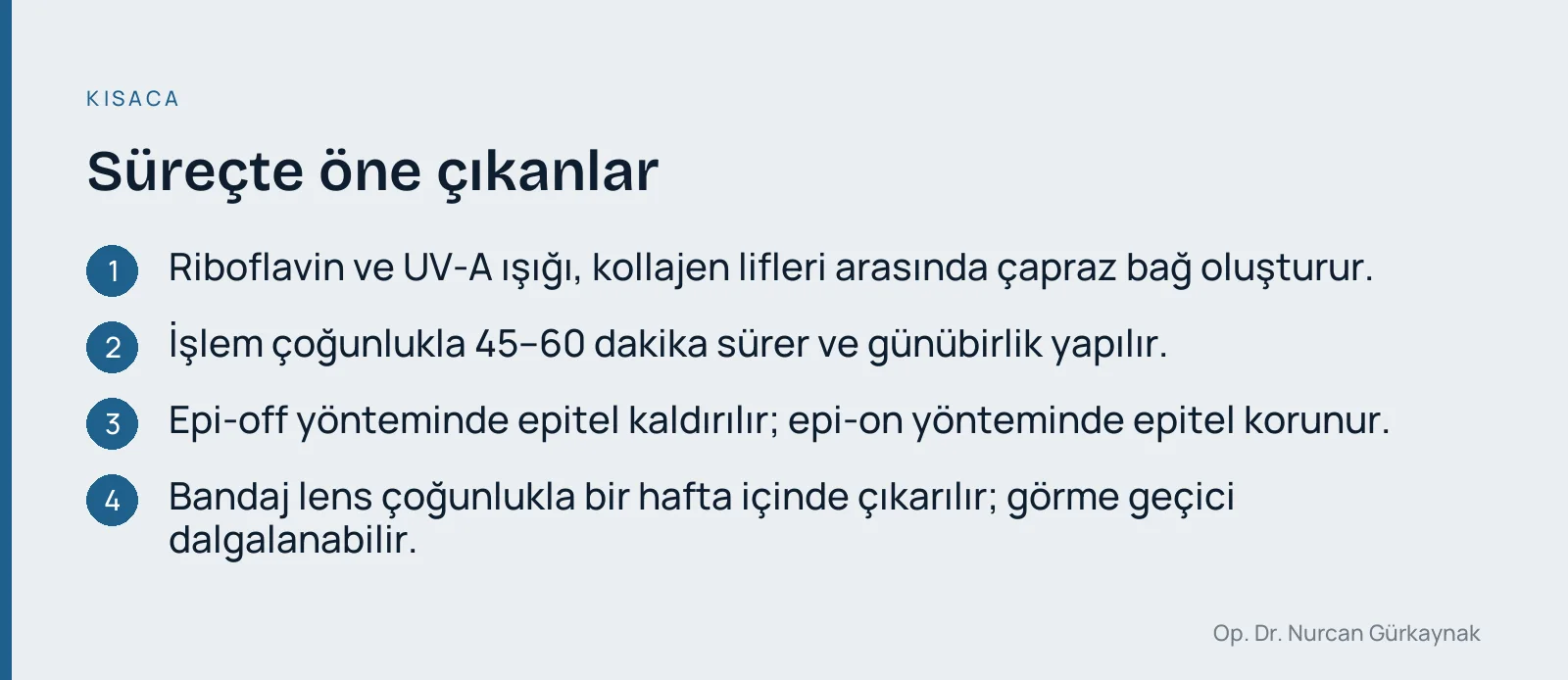
- UV-A light application: UV-A light of a controlled wavelength and dose is directed at the cornea. The combined effect of riboflavin and light creates cross-links between the collagen fibers.
- Protective lens: At the end of the procedure, the surface of the eye is covered with a soft bandage contact lens that provides comfort during healing, and antibiotic/soothing drops are started.
The dose and duration of the light used are set according to specific values in standard protocols; for this reason, the procedure should be performed by an experienced physician using appropriate equipment.
Duration of the Procedure, Anesthesia, and Pain
The cross-linking procedure takes about 45–60 minutes in most patients; including preparation and waiting time, the total may be somewhat longer. The procedure is done as a day case, and a hospital stay is generally not necessary. The duration may vary depending on the protocol used.
The anesthesia used is generally local (topical) anesthesia in the form of eye drops. No pain is expected during the procedure; patients most often describe a feeling of pressure or mild discomfort. However, while the epithelium heals, especially in the first 24–72 hours, burning, stinging, watering, light sensitivity, and a foreign-body sensation may occur. The severity of these symptoms varies from person to person; your doctor will recommend suitable pain relievers and drops.
Differences Between Epi-On and Epi-Off Methods
In the epi-off method, the epithelium is removed, while in the epi-on method the epithelium is preserved and the medication is delivered through this layer. Epi-off has been the most extensively studied approach for many years and is considered the standard. Epi-on, on the other hand, was developed with the goal of increasing comfort and speeding up recovery; however, its effectiveness may vary depending on the protocol.
| Feature | Epi-Off | Epi-On |
|---|---|---|
| Epithelium | Removed | Preserved |
| Medication penetration | Direct, easier | Through the epithelium, more difficult |
| Discomfort after the procedure | May be more noticeable in the first few days | Usually milder |
| Healing | Waits for the epithelium to regenerate | Usually faster |
| Scientific data | Broader and longer-term | Evolving protocols |
Which method is appropriate is decided based on corneal thickness, the stage of the disease, and the physician's clinical assessment.
Recovery Process and What to Watch For
After epi-off cross-linking, the epithelium usually takes a few days to regenerate. The bandage lens is generally removed at the first follow-up visit, within about a week. Vision may be fluctuating or blurry during this period; this is often temporary. Full stabilization of the corneal tissue, however, can take weeks or even months.
Use of glasses: Because cross-linking aims to halt the disease, you may still need glasses or contact lenses after the procedure. Since your prescription may change throughout the healing process, new glasses or a specialty lens fitting are usually planned with your physician's approval, once the cornea has stabilized. For keratoconus patients, options such as specialty contact lenses and corneal rings may also come into play; for more information, you can visit our corneal treatments page.
Dos and don'ts in the first week
Do:
- Use the drops prescribed by your physician at the stated frequency and schedule.
- Wear sunglasses; light sensitivity may increase during this period.
- Attend your follow-up appointments regularly.
- Never touch your eye without washing your hands first; pay close attention to hand hygiene.
Don't:
- Rub your eye; this is a habit that should already be avoided in keratoconus.
- Let your eye come into contact with water, pool water, or seawater.
- Wear eye makeup or spend time in dirty environments.
- Remove the bandage lens or change your drop schedule without your physician's approval.
- Return too early to heavy exercise or activities that strain the eyes.
If you would like an idea of general daily care principles after eye surgery, our article on what to watch out for after cataract surgery can also be a helpful guide in terms of hygiene and drop use. However, the recovery plan differs for every procedure; what matters most is your own physician's instructions.
Possible Risks, Side Effects, and Complications
When performed with proper patient selection, cross-linking is generally considered a safe procedure; still, like any medical intervention, it carries risks. Possible conditions include:
- Temporary side effects: Pain, watering, redness, light sensitivity, and temporary blurred vision.
- Corneal haze: It usually decreases over time and, rarely, may be permanent.
- Infection: Because the epithelium is removed, there is a risk of corneal infection, albeit rare; this is why drop use and hygiene are important.
- Delayed epithelial healing: In some patients, surface regeneration may take longer than expected.
- Inadequate response: In some eyes, the disease may progress despite the procedure; additional treatment may be needed in this case.
If you experience symptoms such as severe pain, a sudden decrease in vision, increasing redness, or discharge, you should contact your physician without delay.
Who Is It Suitable For, and Who Is It Not?
Cross-linking is most often considered for patients with progressive keratoconus and for certain corneal ectasias (for example, corneal thinning after refractive surgery). The decision is made based on changes in corneal mapping measurements over time, the patient's age, and examination findings. Because the disease can progress faster in young patients, follow-up is especially important.
The procedure may not be suitable, or may be postponed, in the following situations:
- Insufficient corneal thickness (there are threshold values depending on the protocol).
- Active eye infection or significant corneal scarring.
- Pregnancy and breastfeeding; be sure to inform your physician about this.
- Certain ocular surface diseases that may make epithelial healing difficult.
- Special circumstances such as a history of herpetic corneal disease; the physician will conduct an individual assessment.
The decision on suitability can only be made through an in-person examination; the information in this article does not constitute a diagnosis or a personalized treatment recommendation.
Pricing, Insurance Coverage and Frequently Asked Questions
The cost of cross-linking varies depending on the method and materials used and the center where the procedure is performed, so it wouldn't be accurate to quote a fixed price. Insurance and SGK (Turkish Social Security Institution) coverage also depends on the institution's current regulations and the patient's individual situation. The most reliable way to get up-to-date information is to ask the clinic, the hospital or the relevant institution directly.
How long does cross-linking surgery take?
In most protocols it takes about 45–60 minutes; including preparation, the total time may be slightly longer.
Is it a painful procedure?
Because anesthetic drops are applied during the procedure, significant pain is not expected. During the first few days, while the epithelium heals, you may experience some discomfort, which is managed with your doctor's recommendations.
Will I be free of glasses after cross-linking?
The goal of the procedure is to halt the progression of the disease; the need for glasses or lenses may often continue. Results vary from person to person.
Can the procedure be repeated?
In rare cases where the disease continues to progress, your doctor may re-evaluate your condition; this decision depends on an individual examination.
If you would like information about options including cross-linking within keratoconus and corneal treatments in Alsancak, İzmir, you can find service details on Op. Dr. Nurcan Gürkaynak's keratoconus page and speak with your doctor to schedule an examination.
Frequently Asked Questions
What is cross-linking surgery?
Cross-linking surgery is a procedure performed to strengthen the corneal tissue. This method helps preserve the shape of the eye by bonding the collagen fibers in the cornea.
How is cross-linking surgery performed?
The surgery is usually performed under local anesthesia. The corneal surface is cleaned, then riboflavin (vitamin B2) drops are applied and activated with UV light.
How long does cross-linking surgery take?
Cross-linking surgery usually takes between 30 minutes and 1 hour. After the procedure, patients are generally advised to rest their eyes for a short time.
What is the recovery process like after cross-linking surgery?
The recovery process after surgery varies from person to person, but visual clarity generally improves within 1–2 weeks. It is important to follow your doctor's recommendations.
What are the side effects of cross-linking surgery?
Side effects may include watery eyes, light sensitivity and mild pain. These symptoms are usually temporary and fade over time.
Who is cross-linking surgery suitable for?
This surgery is suitable for patients with keratoconus or corneal thinning. However, suitability must be assessed by a doctor for each patient.