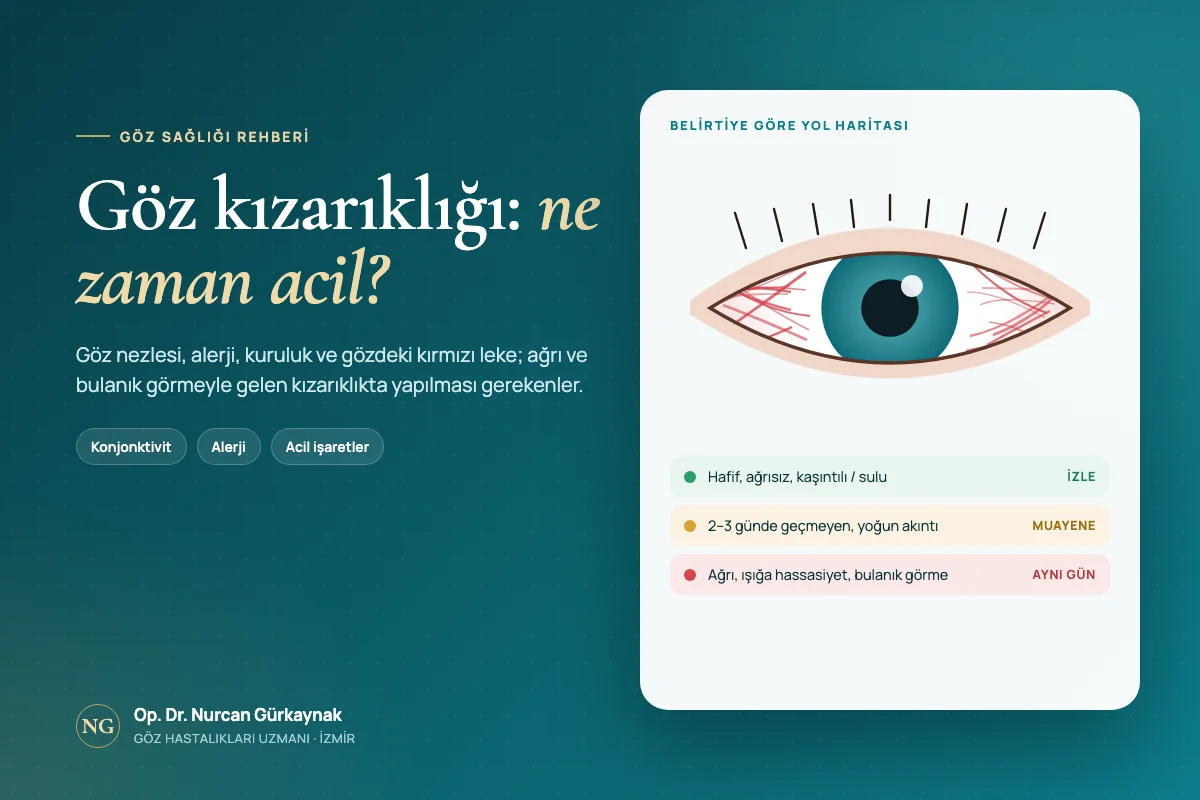
The most common causes of red eyes are conjunctivitis (pink eye), allergies, dry eye, and a small broken blood vessel in the white of the eye; most of these are not serious. However, if the redness is accompanied by eye pain, sensitivity to light, blurred vision, or a severe headache, it may be an emergency such as acute glaucoma (a sudden spike in eye pressure), inflammation inside the eye, or a corneal infection, and you should see an eye doctor the same day.
In this guide, we explain how to tell the possible causes apart based on how the redness looks, any discharge, and accompanying symptoms, what to watch for at home, and which situations should not wait.
Why do eyes turn red?
Red eyes occur when the blood vessels in the conjunctiva, the thin membrane covering the white part of the eye (sclera), or in deeper layers become dilated, or when one of these vessels bleeds. This is how the eye reacts to infection, allergy, dryness, irritation, or inflammation inside the eye.
Redness itself is not a disease but a symptom. The real clues are how the redness is distributed, the type of discharge, whether there is itching or pain, and whether vision is affected.
What are the most common causes of red eyes?
- Viral conjunctivitis (pink eye): Causes watery discharge, a gritty sensation, and widespread redness. It often starts in one eye and spreads to the other within a few days, and may occur along with a cold. It is highly contagious and usually clears up on its own within 1–3 weeks.
- Bacterial conjunctivitis: Produces a yellow-green, sticky discharge; you may wake up in the morning with your eyelashes stuck together. It is treated with antibiotic drops prescribed by your doctor.
- Allergic conjunctivitis: Its most distinctive feature is itching. It usually affects both eyes at once, with watery discharge and eyelid swelling, and gets worse during pollen season and with house dust and pet dander.
- Dry eye: Causes burning, stinging, a gritty feeling, and mild redness that worsens toward the end of the day. Long screen time, air conditioning, and contact lens wear make dryness worse.
- Eyelid margin inflammation (blepharitis): Comes with redness along the lid margins, flaking, and burning that is most noticeable in the morning.
- Subconjunctival hemorrhage: Appears as a painless, bright red patch with well-defined edges on the white of the eye. It can occur after coughing, straining, vomiting, or rubbing the eye.

Is a red patch on the eye dangerous?
A painless, bright red patch that suddenly appears on the white of the eye is most often a subconjunctival hemorrhage and does not affect vision. Although it looks alarming, it usually needs no treatment and disappears on its own within 1–2 weeks, changing color like a bruise.
If the bleeding recurs often, if you take blood-thinning medication, if you have high blood pressure, or if the bleeding occurred after a blow to the eye, an examination is recommended. After a blow to the eye, injuries inside the eye must also be ruled out.
Which red eyes are an emergency?
If the redness is concentrated in a ring around the cornea, if there is noticeable eye pain, or if vision has become blurred, the problem may not be superficial and may involve the deeper layers of the eye. These situations should not wait.
| Condition | Typical symptoms | What to do |
|---|---|---|
| Acute glaucoma attack (angle-closure glaucoma) | Severe eye and head pain, nausea and vomiting, halos around lights, blurred vision | Emergency — every hour counts |
| Inflammation inside the eye (uveitis / iritis) | Ring of redness around the cornea, light sensitivity, deep pain, blurred vision | See an eye doctor the same day |
| Corneal infection (keratitis) — especially in contact lens wearers | Pain, light sensitivity, tearing, a white spot on the cornea, blurred vision | See an eye doctor the same day; remove your lenses |
| Chemical burn | Detergent, limescale remover, cement, etc. getting into the eye | Immediately rinse with plenty of water for at least 15 minutes, then go to the emergency room |
| Foreign object / blow to the eye | Stinging sensation, tearing, inability to open the eyelid | Do not rub; see an eye doctor |

An acute glaucoma attack is a sudden and sharp rise in eye pressure; if treatment is delayed, it can lead to permanent vision loss. For detailed information about high eye pressure, you can visit our glaucoma (eye pressure) page and our guide to early diagnosis of glaucoma.
What should contact lens wearers watch out for?
If your eye becomes red, painful, or bothered by light while wearing contact lenses, remove your lenses immediately and have an eye exam the same day. In lens wearers, redness can be the first sign of a microbial corneal infection as well as simple irritation.
To reduce the risk:
- Do not sleep in your lenses, and do not wear them in the shower or in the pool or sea,
- Do not rinse lenses or their case with tap water; use only the recommended solution,
- Follow the lens replacement schedule; never reuse daily lenses,
- Do not wear lenses when your eyes are red.
For details on lens selection and use, you can read our contact lens page.
What can you do at home, and what should you avoid?
For mild redness that is painless and does not affect your vision, the following steps can help bring relief:
- Do not rub your eye; rubbing increases irritation and redness.
- Apply a cold compress (for allergies and itching) or a warm compress (for inflammation of the eyelid margin).
- Moisturize your eye with preservative-free artificial tears.
- If you have pink eye, wash your hands often and keep your towel and pillowcase separate.
- Do not wear contact lenses or eye makeup until the redness clears.
What you should avoid:
- Do not use "redness-relief" drops for long periods. They temporarily constrict the blood vessels; when you stop using them, the redness can come back even stronger.
- Do not use old drops left over at home, especially cortisone drops, without consulting a doctor. Cortisone drops can worsen some viral infections and raise eye pressure.
- Do not use drops prescribed for someone else.
When should you see an eye doctor?
We recommend an examination if any of the following applies:
- The redness does not improve or gets worse within 2–3 days,
- There is thick, yellow-green discharge,
- There is pain, sensitivity to light or blurred vision in the eye (same day),
- You wear contact lenses and your eye is red and painful (same day),
- The redness appeared after a blow or contact with a chemical (urgent),
- Redness and discharge occur in infants or newborns.
The cause of redness can usually be identified with a simple examination, and the right treatment shortens recovery. You can learn more about general eye examinations and cornea treatments, or book an appointment online.
Frequently Asked Questions
How many days does eye redness last?
It depends on the cause. Redness from mild irritation and dryness usually clears in 1–2 days, viral pink eye in 1–3 weeks, and a red patch caused by bleeding on the eye in 1–2 weeks. Redness that does not improve within 2–3 days should be evaluated with an examination.
Is pink eye contagious?
Viral and bacterial conjunctivitis are contagious; allergic conjunctivitis is not. During pink eye, washing your hands often, not touching your eyes, and not sharing personal items such as towels and pillowcases will prevent it from spreading.
What causes a red spot on the eye?
A painless, bright red spot on the white part of the eye is usually a subconjunctival hemorrhage caused by a small blood vessel breaking. It can appear after coughing, straining, vomiting or rubbing the eye, and it usually clears on its own within 1–2 weeks.
Which drops should be used for eye redness?
The drops are chosen according to the cause of the redness. Artificial tears are used for dryness, antiallergic drops for allergies, and antibiotic drops for bacterial infections. Cortisone and antibiotic drops must only be used on a doctor's recommendation.
What should I do if I have both redness and pain in my eye?
If eye redness is accompanied by pain, sensitivity to light or blurred vision, it may indicate inflammation inside the eye, a corneal infection or an acute rise in eye pressure. In this case, you should see an eye doctor the same day without waiting.
Can lack of sleep cause eye redness?
Yes. Lack of sleep can disrupt the tear film, leading to dry eyes and mild redness. This type of redness usually goes away with rest and moisturizing drops; if it does not, other causes should be investigated.
Related Guides
- Dry Eye: Symptoms and Modern Treatments
- Glaucoma: Early Diagnosis Against the Silent Thief of Sight
- What Causes Eye Twitching? When Does It Go Away?
- Drooping Eyelid (Ptosis): Causes and Treatment
This article is for general information only and is not a substitute for an examination. For your symptoms, please consult an ophthalmologist.