
Ptosis (drooping eyelid) is when the upper eyelid sits lower than it should. In adults, the most common cause is the age-related loosening of the tendon of the muscle that lifts the eyelid, and treatment is usually a short eyelid surgery. However, not every drooping eyelid is the same: ptosis that starts suddenly, or comes with double vision or a severe headache, requires urgent evaluation; in children, an early exam is important because of the risk of lazy eye.
In this guide, we explain the types of ptosis, how it differs from excess sagging skin, the surgical options, and the recovery process.
What is a drooping eyelid (ptosis)?
Ptosis is when the edge of the upper eyelid rests lower than where it normally should. Normally, the upper eyelid covers about 1–2 mm of the top edge of the dark part of the eye (the cornea). In ptosis, the eyelid sits lower; in advanced cases, it reaches over the pupil and blocks the upper part of the visual field.
Ptosis can affect one eye or both eyes. People often notice it as a "tired or sleepy look." As the field of vision narrows, they begin to raise their eyebrows or tilt their head back to see, which can lead to forehead and neck fatigue by the end of the day.
What causes ptosis?
The cause of ptosis is classified according to where the problem lies in the chain of the system that lifts the eyelid (the levator muscle, its tendon, and the nerve that controls it):
- Age-related (aponeurotic) ptosis: This is the most common type in adults. The tendon that attaches the levator muscle to the eyelid thins and loosens over time. Long-term use of hard contact lenses, frequent eye rubbing, and previous eye surgeries can speed up this process.
- Congenital ptosis: This is caused by the levator muscle not developing sufficiently from birth. If the eyelid covers the pupil, lazy eye (amblyopia) can develop in the child.
- Neurogenic ptosis: This results from problems in the nerve that controls the muscle lifting the eyelid. Third cranial nerve palsy or Horner syndrome belong to this group.
- Myogenic ptosis: This is seen in neuromuscular junction diseases such as myasthenia gravis. It typically varies throughout the day, getting worse in the evening and with fatigue.
- Mechanical ptosis: A mass, swelling, or scar tissue in the eyelid weighs it down and pulls it lower.
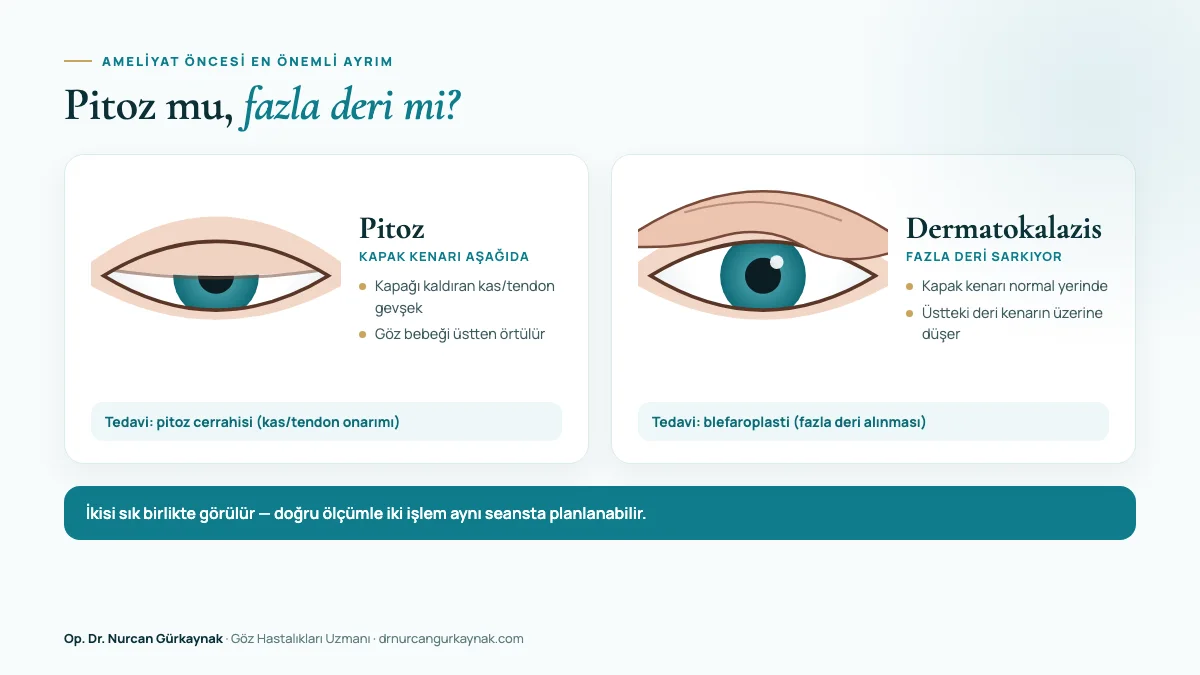
Ptosis or excess skin? How can you tell the difference?
In ptosis, the eyelid margin itself is lower; in excess sagging skin (dermatochalasis), the eyelid margin is in its normal position, but the extra skin above it hangs over the margin. This distinction matters because the surgery for each condition is different.
| Feature | Ptosis (drooping eyelid) | Dermatochalasis (excess skin) |
|---|---|---|
| Source of the problem | The muscle that lifts the eyelid or its tendon | Loosening of the upper eyelid skin |
| Eyelid margin | Lower than normal | In normal position, skin hangs over it |
| Age at which it is common | Any age; in adults, mostly 50+ | Mostly over age 40 |
| Surgery | Ptosis surgery (muscle/tendon repair) | Blepharoplasty (removal of excess skin) |
| Can they occur together? | Yes — both procedures can be planned in the same session | Yes |
In many patients, both conditions are present together. If only the excess skin is removed and the underlying ptosis is not corrected, the "tired look" may persist even after surgery. For this reason, having the pre-operative evaluation performed by an eye doctor ensures that the functional and aesthetic results are planned together. For more information, you can visit our eye aesthetics and oculoplasty page.
Which ptosis is an emergency?
If the drooping eyelid started suddenly and is accompanied by any of the following, you should go to the emergency room without delay:
- Double vision or inability to move the eye in one direction,
- Enlargement of the pupil on that side,
- Severe headache, neck pain, nausea and vomiting,
- Weakness in the face, speech difficulty, or numbness in the arm or leg.
These symptoms may be signs of nerve palsy or an urgent problem involving the blood vessels of the brain. Ptosis that varies during the day, worsens in the evening, and comes with double vision also requires a neurological evaluation for myasthenia gravis.
Why is ptosis important in children?
If a drooping eyelid covers the pupil in a child, lazy eye can develop because the brain does not receive a sufficient image from that eye. Ptosis can also cause astigmatism, and the child may develop a habit of tilting their head back in order to see.
The visual development of every child with congenital ptosis should be monitored regularly. In cases that threaten vision, surgery is planned at an early age; in milder cases, the child can be monitored with glasses and patching therapy, and surgery can be postponed to a later age. For details on children's eye health, you can read our children's eye health guide for families.
How is ptosis treated?
The permanent treatment for ptosis is surgery. The surgical method is chosen according to the cause of the ptosis and, in particular, how strongly the muscle that lifts the eyelid functions. During the exam, the distance between the eyelid margin and the pupil, the strength of the eyelid muscle's movement, the position of the eyelid crease, dry eye, and brow position are measured.
- Levator advancement (external approach): The surgeon enters through the eyelid crease and re-secures the loosened tendon in its place. It is the most commonly used method in age-related ptosis; if needed, excess skin can also be removed through the same incision.
- Internal approach (Müller's muscle resection): This is performed from the inner surface of the eyelid, leaving no scar on the skin. It may be preferred in mild-to-moderate ptosis where muscle strength is good.
- Frontalis sling: When the eyelid muscle is very weak (especially in some congenital ptosis cases), the eyelid is lifted by connecting it to the forehead muscle.
In causes such as myasthenia gravis, the underlying disease is treated first. In some countries, eye drops that temporarily lift the eyelid by a few millimeters are used for mild acquired ptosis; however, their effect is temporary and they are not a substitute for surgery.
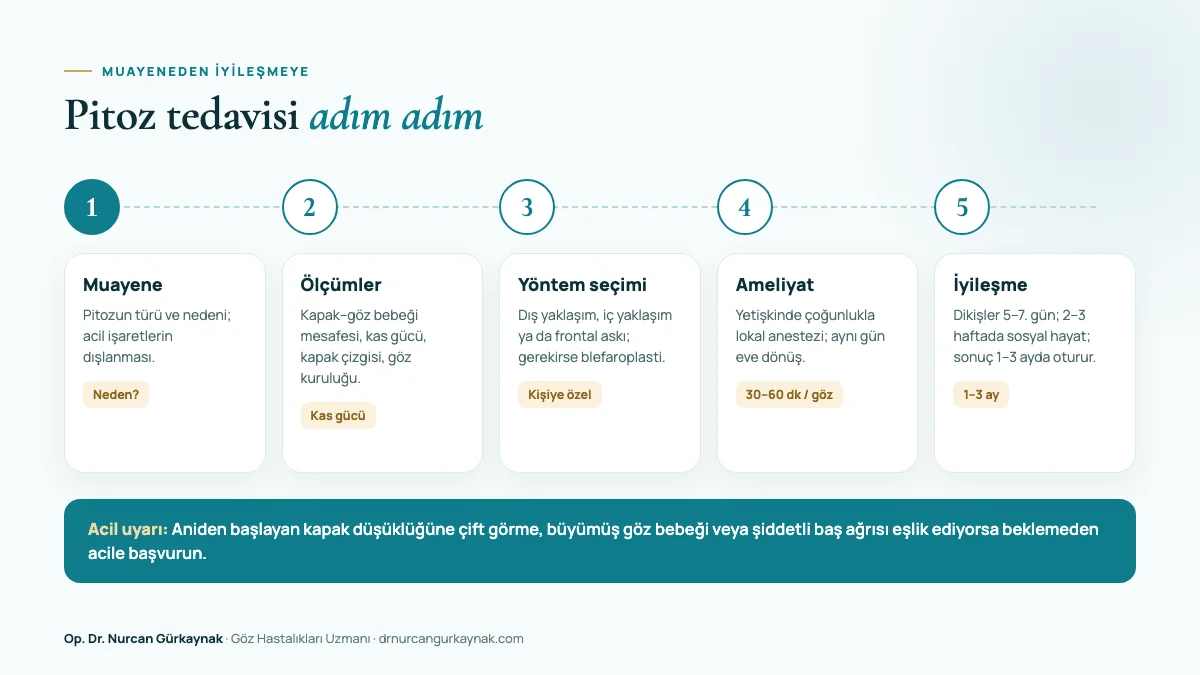
What Is the Surgical Process and Recovery Like?
In adults, ptosis surgery is most often performed under local anesthesia, and the patient goes home the same day. The advantage of local anesthesia is that the patient can open and close the eye during the procedure, allowing the eyelid height to be adjusted in real time. General anesthesia is preferred for children.
| Period | What to expect |
|---|---|
| First 48 hours | Cold compresses and sleeping with the head slightly elevated; mild swelling and tightness are normal |
| Week 1 | Bruising and swelling subside; stitches are usually removed on day 5–7 |
| Weeks 2–3 | Most people return to their social life and desk work |
| Months 1–3 | The eyelid shape settles and scars mature; the final result is assessed |
In the first weeks after surgery, the eyelid may not close completely and you may experience a feeling of dry eye; moisturizing drops and gels are used during this period. You should wait for the length of time recommended by your doctor before lifting heavy objects, working while bending over, swimming, or wearing makeup. If you have dry eye complaints, you can find additional information on our dry eye page.
A detailed eyelid examination is needed to determine the type of your eyelid drooping and the treatment that suits you. You can learn more about eye aesthetics and oculoplasty or book an online appointment.
Frequently Asked Questions
Does drooping eyelid go away on its own?
Age-related or congenital ptosis does not resolve on its own; over time it may stay the same or worsen. Ptosis caused by swelling, infection, or certain nerve palsies may improve once the underlying cause is resolved. For this reason, the cause of the ptosis must be determined first.
Does ptosis surgery leave a scar?
With the external approach, the incision is hidden in the natural eyelid crease and is usually not noticeable after healing. With the internal approach, no incision is made on the skin at all. How visible a scar is varies from person to person depending on skin type and the healing process.
How long does ptosis surgery take?
It usually takes 30–60 minutes for one eye and about 1–1.5 hours for both eyes. In adults it is mostly performed under local anesthesia, and the patient is discharged the same day.
Are ptosis and blepharoplasty the same thing?
No. Ptosis surgery repairs the muscle or tendon that lifts the eyelid, whereas blepharoplasty removes excess skin and fat tissue from the upper eyelid. If both problems are present, the two procedures can be performed in the same session.
Is eyelid drooping after Botox permanent?
Eyelid drooping that occurs after botulinum toxin injection is usually temporary and in most cases resolves within a few weeks. During this time, your doctor may recommend drops that help temporarily lift the eyelid.
My child has a drooping eyelid. When should surgery be done?
If the eyelid covers the pupil and there is a risk of lazy eye, surgery can be planned at an early age. In mild cases that do not affect vision, the child is monitored with regular eye examinations and surgery can be postponed to an older age. The decision must always be made after an examination.
Related Guides
- What Causes Eye Twitching? When Does It Go Away?
- What Causes Red Eyes? When Is It an Emergency?
- Eye Health and Strabismus in Children: A Guide for Parents
- Dry Eye: Symptoms and Modern Treatments
This article is for general information purposes only and is not a substitute for an examination. Please consult an ophthalmologist for your concerns.