With the right lens choice and a suitable eye structure, life without glasses after cataract surgery is largely possible for most patients; however, being completely glasses-free cannot be guaranteed for every patient. In cataract surgery, the eye's clouded natural lens is removed and replaced with an artificial intraocular lens (IOL). The type of lens you choose determines how glasses-free your distance, intermediate and near vision will be.
What does an intraocular lens (IOL) do in cataract surgery?
An intraocular lens (IOL) is a clear artificial lens placed inside the eye to replace the natural lens removed because of a cataract, focusing light onto the retina. Because the lens provides a significant share of the eye's total focusing power, your choice directly affects the quality of your vision after surgery.
In youth, the natural lens can adjust its focus automatically. With age, this flexibility declines and the need for reading glasses arises. Standard artificial lenses do not mimic this flexibility. That is why lens selection comes down to the question: "Which distance do I want to see without glasses?"
What is the difference between a monofocal lens and a multifocal lens?
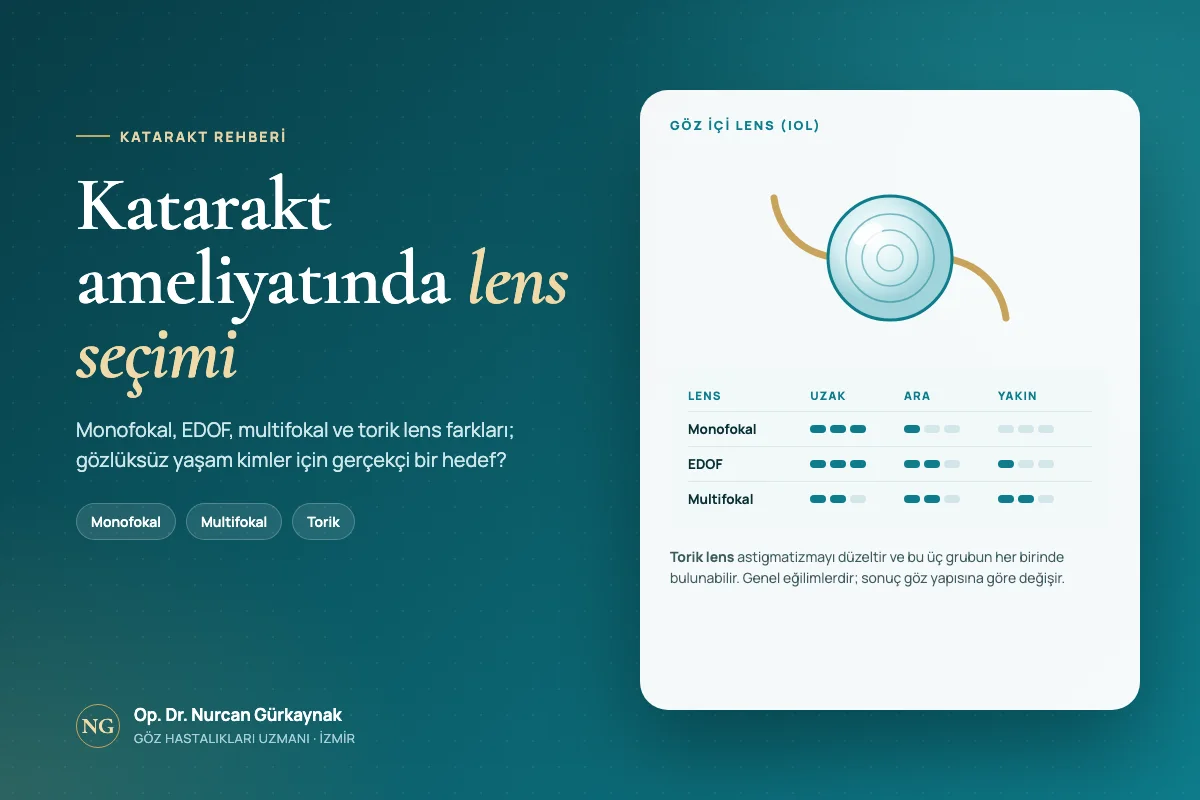
A monofocal lens has a single focal point, whereas a multifocal lens is an intraocular lens that splits light into more than one focus, aiming for both distance and near vision at the same time. There are four main groups on the market:
- Monofocal lens: Usually set for distance vision. Glasses are needed for close-up reading. It offers high contrast sensitivity and a relatively low risk of glare in night vision.
- Multifocal lens: Offers separate focal points for distance and near, and in some models for intermediate distance too. It aims to reduce dependence on glasses.
- EDOF (extended depth of focus) lens: Creates a single extended range of focus. It performs well at distance and intermediate range (computer, phone, car dashboard); light glasses may be needed for very close reading.
- Toric lens: A lens designed to correct astigmatism (cylindrical error). Toric versions may be available on monofocal, EDOF or multifocal platforms.
How does each lens affect distance, intermediate and near vision?
The table below summarizes the general tendencies of each lens group. Individual results vary depending on eye structure and surgical planning.
| Lens type | Distance | Intermediate | Near | Halo/glare risk |
|---|---|---|---|---|
| Monofocal | Very good | Limited | Glasses needed | Low |
| EDOF | Very good | Good | Glasses may be partly needed | Low-medium |
| Multifocal | Good | Good (depending on model) | Good | Medium-high |

Will I be completely free of glasses with a multifocal lens?
No, not for every patient. Clinical studies show that most patients with multifocal lenses use glasses significantly less; however, some patients may still need light glasses for situations such as reading very small print or reading in dim light.
Multifocal lenses have some known side effects:
- Seeing rings or halos around lights at night
- A slight reduction in contrast sensitivity
- An adaptation period of weeks to months while the brain adjusts
These effects fade over time in most patients, but discomfort may rarely persist, and in very rare cases a lens exchange may be considered.
Is a multifocal lens suitable for everyone in cataract surgery?
No, a multifocal lens is not suitable for everyone. According to experts, the ideal candidate is a patient with good eye health who can accept some visual trade-offs in exchange for a life without glasses.
Multifocal lenses are generally not recommended in the following cases:
- Retinal and nerve diseases such as macular degeneration, diabetic retinopathy or advanced glaucoma
- Corneal surface disorders or severe dry eye
- An irregular corneal structure after previous laser eye surgery
- People who drive a lot at night or work in professions where contrast sensitivity is critical (pilots, professional drivers, etc.), who require careful evaluation
- People with perfectionist expectations and low tolerance for even the slightest glare
Which lens is used in cataract surgery if I have astigmatism?
A toric lens is generally preferred for patients with astigmatism. A toric lens corrects the cylindrical error caused by the cornea's irregular curvature through its own design, which reduces the need for separate glasses for astigmatism.
It is important to be aware of some limitations:
- For a toric lens to work effectively, it must sit on the correct axis. In rare cases the lens can rotate and may need to be repositioned.
- Irregular astigmatism (for example, keratoconus) may not be fully corrected with a toric lens.
- In low-grade astigmatism, the surgeon can also make a correction by adjusting the incision site.
Corneal topography and biometry measurements taken before surgery form the basis of this decision.
What factors determine lens selection?
Lens selection is based not on a single criterion but on the patient's overall profile. The main factors are:
- Lifestyle: Sports, travel and outdoor activities may make a multifocal or EDOF lens appealing.
- Profession: For those who work a lot at a computer, intermediate distance comes to the fore; for those who drive at night, the risk of glare matters.
- Current eye health: The condition of the retina, cornea and optic nerve may limit the suitable lens group.
- Expectations and tolerance: Willingness to accept mild visual side effects is decisive.
- Eye measurements: Eye length, corneal curvature and pupil diameter all influence planning.

Does the price difference between lenses change the outcome?
Price alone does not determine the quality of the result. Advanced lenses usually cost more, but the most expensive lens is not the best option for every eye. For example, in an eye with a retinal disease, a multifocal lens may deliver lower visual quality than a standard monofocal lens, despite the additional cost.
The factors that truly determine the outcome of the surgery are:
- Accurate measurement: Precise calculation of lens power through biometry and corneal topography.
- The right lens category: A choice suited to your eye health, lifestyle and expectations.
- Surgical experience: Correct placement of the lens and proper axis alignment with toric lenses.
- Post-operative follow-up: Check-up examinations and additional corrections when needed.
Standard lenses are generally covered by health insurance, while advanced lenses such as multifocal, EDOF or toric may involve an additional fee. Since coverage and difference fees vary from one institution to another, they should be clarified before surgery.
Determining the most suitable lens for you requires a detailed cataract examination and measurements. You can learn more about cataract surgery or book an online appointment.
Related guide: What to Watch Out for After Cataract Surgery: A Daily Guide
Frequently Asked Questions
What is a multifocal lens in cataract surgery?
A multifocal lens is a special type of lens that provides clear vision at different distances. By meeting both near and distance vision needs, these lenses make a glasses-free life possible.
Is a glasses-free life possible after cataract surgery?
Yes, a glasses-free life is possible with multifocal lenses after cataract surgery. These lenses allow patients to go about their daily activities comfortably without wearing glasses.
What are the advantages of multifocal lenses?
Multifocal lenses offer clear vision at both near and far distances, reduce the need for glasses and improve quality of life. They also provide greater freedom in everyday life.
How is the lens chosen in cataract surgery?
The lens is selected by taking into account the patient's lifestyle, eye health and visual needs. The doctor carries out a detailed evaluation with the patient to determine the most suitable lens type.
What is the recovery process like after cataract surgery?
Recovery after cataract surgery is usually quick. Most patients notice a significant improvement in their vision within the days following the operation, although full recovery may take a few weeks.
Related Guides
- Cataract Symptoms and Surgery: Everything You Wonder About
- Floating Black Spots in the Eye: When Is It Normal, When Is It an Emergency?
- Retinal Diseases: Macular Degeneration and Diabetic Retinopathy
- Dry Eye: Symptoms and Modern Treatments
This article is for general information purposes only and is not a substitute for an examination. Please consult an ophthalmologist about your symptoms.